Soccer Guides / Laws of the game explained
The basics: field, ball, players and match length
The numbers every fan should know, from the size of the goal and the penalty spot to how long a match lasts and how many players each team needs.
Seventeen Laws, one global game
The Laws of the Game are published by the International Football Association Board (IFAB), a body founded in 1886 by the four British football associations. FIFA joined in 1913, and today FIFA holds four votes and the four British associations hold one each. A change needs six of the eight votes, which is why the Laws evolve slowly and carefully. The same Laws apply in a World Cup final and, with some allowed modifications, in a youth game in your local park.
The 17 Laws cover the field, the ball, the players, equipment, the referee, the other match officials, match duration, starting and restarting play, ball in and out of play, determining the outcome, offside, fouls and misconduct, free kicks, the penalty kick, the throw-in, the goal kick and the corner kick.
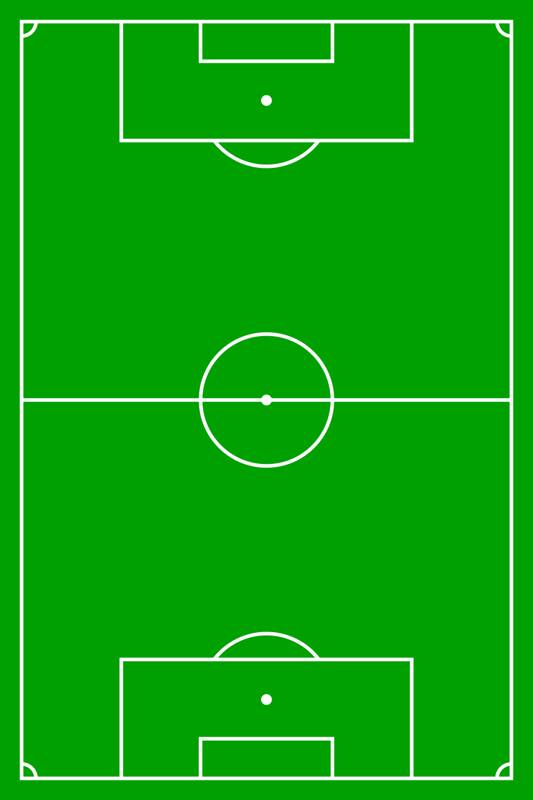
The field of play
Law 1 allows a range of sizes rather than one fixed size.
| Marking | Measurement |
|---|---|
| Length (any match) | 90 to 120 m (100 to 130 yd) |
| Width (any match) | 45 to 90 m (50 to 100 yd) |
| Length (international matches) | 100 to 110 m |
| Width (international matches) | 64 to 75 m |
| Goal | 7.32 m wide, 2.44 m high (8 yd by 8 ft) |
| Penalty spot | 11 m (12 yd) from the goal line |
| Penalty area depth | 16.5 m (18 yd) |
| Goal area depth | 5.5 m (6 yd) |
| Center circle radius | 9.15 m (10 yd) |
The 9.15 m figure appears everywhere: it is also the distance opponents must stand from the ball at free kicks and corners. Most professional clubs play on a field close to 105 m by 68 m.
The ball
A standard ball (size 5) has a circumference of 68 to 70 cm and weighs 410 to 450 g at the start of the match. Youth leagues use smaller balls: size 4 is common for roughly ages 8 to 12 and size 3 for younger children, although local rules vary. See our equipment guide for more.
Players and substitutes
A match is played by two teams of up to 11 players, one of whom must be the goalkeeper. Under the 2026/27 Laws, a match cannot start or continue if either team has fewer than seven players, and a team responsible for an abandonment can in principle forfeit the match. Every team must have a captain wearing an armband. Substitution numbers are covered in our substitutions guide.
How long a match lasts
- Two halves of 45 minutes each.
- Half-time may not exceed 15 minutes.
- The referee adds time for substitutions, injuries, VAR checks, goal celebrations, time-wasting and other stoppages. This is called added time or stoppage time, and the minimum is shown by the fourth official on a board.
- If a knockout match must have a winner, competitions may use extra time and a penalty shoot-out.
Youth matches are usually shorter, and many youth formats use fewer players on smaller fields.
Winning a match
A goal is scored only when the whole ball crosses the whole goal line between the posts and under the crossbar. A ball resting on the line, even by a few millimeters, is not a goal. Many top competitions use goal-line technology that alerts the referee's watch within a second.
A goal can be scored directly from a kick-off, a direct free kick, a penalty, a corner kick and a goal kick, but not directly from a throw-in or an indirect free kick.