Soccer Guides / Competitions explained
Champions League format explained
How Europe's top club competition works since its 2024/25 redesign, from qualifying and the 36-team league phase to the knockout playoffs and the single-match final.
What it is
The UEFA Champions League is the top club competition in European soccer, organized by UEFA. It began in 1955 as the European Champion Clubs' Cup, usually called the European Cup, and was rebranded as the Champions League in 1992. Teams qualify through their finishing position in their national league, with stronger leagues receiving more places.
From the 2024/25 season, UEFA replaced the traditional group stage with a single league phase, sometimes called the "Swiss model."
The league phase
| Feature | Detail |
|---|---|
| Teams | 36 |
| Matches per team | 8, against 8 different opponents |
| Home and away | 4 home matches and 4 away matches |
| Opponents | Drawn from four seeding pots, two from each pot |
| Table | One combined table of all 36 teams |
Because teams do not all play each other, the draw matters: each club gets a different schedule. Software helps UEFA create a fixture list that respects the pots and rules such as not facing a club from your own country in the league phase.
Who goes through
| League phase position | Outcome |
|---|---|
| 1st to 8th | Qualify directly for the round of 16 |
| 9th to 24th | Enter a two-legged knockout phase playoff |
| 25th to 36th | Eliminated from European competition for the season |
The 16 winners of the knockout phase playoffs join the top eight in the round of 16. Finishing high in the table also brings advantages later, such as playing the second leg of knockout ties at home.
The knockout rounds
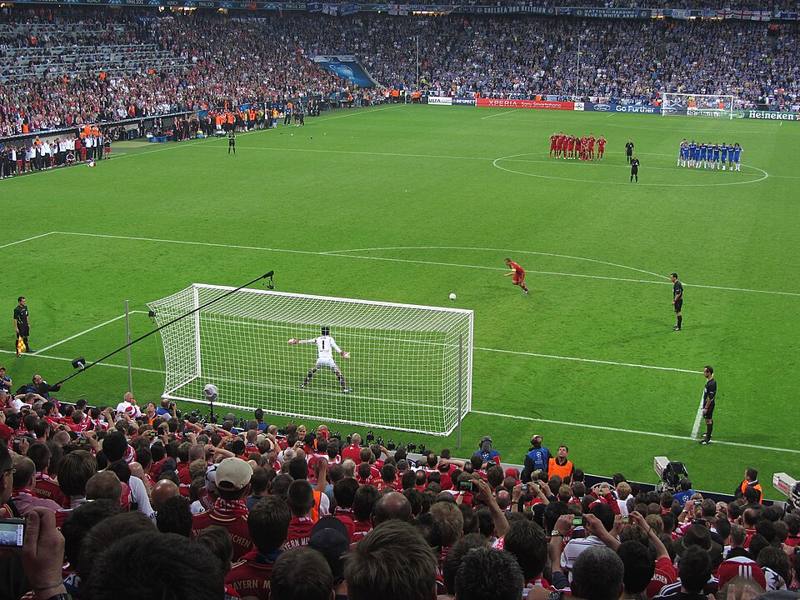
From the round of 16 through the semifinals, ties are played over two legs, one at each club's stadium. The team with more total goals across both matches, the aggregate score, goes through. Away goals no longer count double; UEFA scrapped that rule from 2021/22. If the aggregate is level after the second leg, the match goes to extra time and then a penalty shootout. See extra time and shootouts.
The final is a single match at a venue chosen in advance.
Comparing old and new
| Old group stage (to 2023/24) | League phase (from 2024/25) | |
|---|---|---|
| Teams | 32 | 36 |
| Format | 8 groups of 4 | One table of 36 |
| Matches per team | 6 | 8 |
| Direct to round of 16 | Top two in each group | Top eight overall |
| Playoff round | No | Yes, for 9th to 24th |
Reading the table
League phase tables show points (3 for a win, 1 for a draw), goal difference and goals scored. When clubs are level, UEFA's regulations set the order of tiebreakers, which you can find on UEFA's website. See live-score terms for column abbreviations.
The wider family
UEFA runs two more club competitions with the same league phase idea: the Europa League and the Conference League. Winners of those competitions also earn places in higher competitions the following season, so the European calendar is closely linked.
Real Madrid has won the European Cup and Champions League more times than any other club.